Most people book a mainstream hotel based holiday out of habit. A hotel, a tour bus, a pre-packaged itinerary, a view from a window. It's familiar, and that's fine.
But there's another way to travel. One where you're not a passenger watching the world go past, rather, you scratch past the surface and enter inside it. And once you've experienced a multi-day walking tour, the comparison becomes almost unfair. Here's how others describe a trekking or walking tour with World Expeditions.
Walking Tours Offer Genuine Interactions
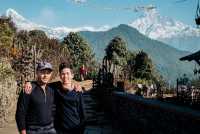
There's a difference between seeing a place and being inside it. Patrick O'Shea, returning to Nepal for his second trek through the Annapurna region, described the colours of the forests he was trekking through as so vivid it was like "turning up the saturation in Lightroom." Not a photograph. Not a window. That's his pic below - earned on foot.
Bettina and Michael Press have completed 11 trips with World Expeditions. On their Api Himal Exploratory in remote western Nepal, they encountered a village that welcomed them with singing and dancing, the kind of unique cultural moment that no regular itinerary can manufacture without a prior booking. Six weeks after coming home, they were still in awe of that one moment.
Slowing down to a walking pace is when the world has a chance to actually reveal her real beauty.
It's An Emotional AND Physical Experience
The science is straightforward. Walking releases endorphins, dopamine and serotonin simultaneously, your body's natural mood regulators and focus enhancers, all at once. It strengthens your heart, sharpens cognitive function, improves sleep and reduces chronic disease risk.
Author and National Museum of Australia curator Jono Lineen, who has spent years researching movement and the mind, puts it simply: "We grow wiser through walking."
Wellness advocate Di Westaway calls it lifestyle medicine. You come home from a walking holiday not just rested but restored: fitter, clearer and more capable than when you left. That's a return on investment on yourself, which adds to your happiness.
It's The Simple Things That Really Make You Happy
When you're on the trail, the mental noise around your busy life stops. There are no emails, no notifications, and if you're really lucky (yes, many will disagree!) - no phone service (although you'll be pleased to know that you can buy internet access vouchers in some of the remotest places in the Himalaya - weather permitting). Your entire daily focus narrows to something beautifully simple: what's around the corner, how are your trekking companions, and most importantly, what's for dinner.
Psychologists call it attentional restoration, the mind's ability to recover when freed from the constant demands of modern life. Walkers just call it plain happiness.
Good food cooked by professional cooks over a camp stove tastes better than anything from a laminated restaurant menu. A sleeping bag under a sky full of stars feels like the most natural thing in the world. Waking up to a mountain view that took you three days to earn produces a quiet joy that a hotel room simply cannot replicate. There is something deeply restorative about stripping life back to its basic essentials in some of the most inspiring places on earth, like making a new friend.
This is our version of real happiness.
It Gives You A Reason to Commit To Training
Here's something most holidays don't give you: a reason to get fit beforehand.
Knowing you have a trek coming - whether it's an introductory walk in the foothills of the Himalaya or scaling one of its peaks - gives you a tangible goal to work towards in the weeks and months before you go. The preparation becomes part of the entire experience. You arrive fitter than you've been in years, and you spend two or three weeks putting that fitness to a use that will reward you tenfold.
Dragica Barac (below) had never done a multi-day hike before she tackled the Jatbula Trail in Australia's Top End. She'll tell you she nearly quit after five minutes. She didn't, and she came home unable to stop talking about it.
Peter Griffith was the least experienced trekker in his entire Everest Three Passes group (a tough trek). He completed it without altitude medication and is enormously proud of his personal achievement on this high altitude trek. Helen Lloyd Martin, after the Classic Larapinta Trek in Australia, wrote: "They helped me achieve something I didn't know I was capable of until now."
If you've never tried it, how do you know you can't? The range of people who try a walking or trekking tour is wider than you might think.
Walking Holidays Are for Everyone
There's a common misconception that trekking and walking holidays are the domain of the ultra-fit or the seriously adventurous. They're not.
World Expeditions offers trips across a full range of grading, from relaxed introductory walks through spectacular landscapes to multi-week high altitude expeditions for the experienced.
Families have walked together on the Larapinta. Couples chosen Nepal as a honeymoon. Travellers in their 60s and 70s completed the Overland Track. People who have never camped before come home converts after an Eco-Comfort Camp trek. They enjoy the moments that brought them pure happiness, it far outweighs any physical hardships.
And here's something that surprises most first-timers about places like Nepal: you don't have to trek to Everest Base Camp to see Mt Everest, the world's tallest peak. Some of the most breathtaking mountain panoramas in the world are found on shorter, more accessible treks at lower altitudes, where the views are actually wider, the air is warmer, and the experience is no less extraordinary. The great peaks are often best appreciated from a distance, spread across the whole horizon rather than looming directly overhead.
A 7 to 10-day trek anywhere can deliver views that stop you in your tracks without the need for high altitudes or extreme fitness.
It's a Style of Travel That Gives Back - to You and to Others
As a saying goes, travel is the only thing you buy that makes you richer. But only if it enriches both sides of the exchange. A walking holiday that moves through remote villages, employs local guides, purchases food from isolated communities and puts tourism income into places that rarely see it creates something a resort stay rarely does: genuine mutual benefit.
On Nepal's trails, a single expedition employs porters, cooks, guides and support staff from some of the most remote regions on earth. On the Larapinta, the Jatbula, in Bhutan and beyond, the economics of walking travel flow outward. You come home richer in experience. The communities you passed through are richer too, and that makes you feel better about your travel choices.
That's what real value looks like.
Million Dollar Views. Without the $$$$$ Tag.
Think about what a week in a mid-range hotel actually costs once you add it all up - the room, the meals out every night, the day tours booked separately, the entry fees, the transfers. It adds up quickly, and most of it is forgotten within a month.
Now consider that for a similar outlay, a guided walking holiday covers two to three weeks of accommodation, all meals, expert guiding and logistics, and every single morning, you wake up to a view that no five-star hotel can put a price on, because the only way to get there is on foot. The Torres del Paine at sunrise with a handful of other people. The Himalaya spread across the horizon from a ridge you earned. The Milky Way undimmed above a camp in the Australian wilderness.
These are not experiences you can upgrade your way into with points. You put in the effort - you get the rewards, And compared to what you'd spend to feel a fraction of that in a luxury resort, the maths is surprisingly straightforward. That'll make Dad happy!
The Memories Stay With You Forever
There's a reason people who complete a hike that may have challenged them recall them fondly years later. The memories formed on a walking holiday are vivid in a way that a hotel stay rarely produces, because they were earned. The cold of a high pass at dawn. The moment a mountain appears through cloud. The dinner around a camp table with people who were strangers a week ago. These are not experiences that fade into a general blur of pleasant holidays.
When you share those moments with others - a partner, a friend, a group of people you met on day one and won't forget for the rest of your life - they get better. Research consistently shows that shared experiences form our strongest and most enduring memories. A walking holiday delivers them in abundance.
Matt Brazier (below), who completed the Bhutan Snowman Trek after dreaming about it for a decade, put it simply: "I really will never ever forget it."
The Road Less Travelled
Robert Frost wrote about two paths in a wood and the quiet significance of choosing the less worn one. "I took the one less travelled by, and that has made all the difference."
It's the philosophy World Expeditions has operated on since 1975. The path that asks a little more of you, yet gives back far more in return.
Tony Forster (pictured below) has Parkinson's Disease. At the time of writing, he was trekking at 3,800 metres in Kyrgyzstan. Moving slowly, trusting his guide, fully present. His words: "I am still in the game. That's what matters. Life is good."
Are you still in the game? Your path to happiness is there. You just have to choose it. We can help.
Browse our walking and trekking holidays, or talk to one of our trip consultants about where to start.