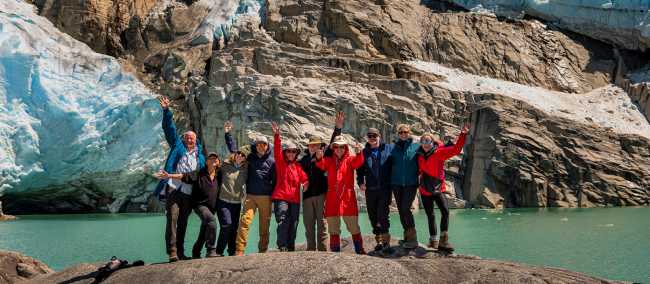
Enjoy Patagonia's extraordinary glaciers | Lachlan Gardiner
Patagonia is a vast, sparsely populated region spanning the southern tip of South America, shared between Chile and Argentina. The heart of it is concentrated in the far south, where the Andes compress into dramatic peaks, the Southern and Northern Patagonian Icefields send glaciers down to meet the lakes, and the landscape shifts from dense beech forest to open steppe to sheer granite in the space of a single afternoon.
The two most famous destinations are Torres del Paine National Park in Chile and Los Glaciares National Park in Argentina, home to the legendary Fitzroy Massif and Perito Moreno Glacier. But beyond these well-known anchors lies a much larger, wilder Patagonia that most visitors never reach.
So, What Makes Patagonia So Special?
The Mountains Are Extraordinary and Accessible
Unlike the Himalaya, where you need days of acclimatisation before getting anywhere near serious terrain, Patagonia's most dramatic landscapes sit at relatively low altitude. Treks rarely push above 1,000 metres. You don't need specialised climbing skills or weeks of preparation. You just walk, and the mountains reward you immediately.
The Scale Is Hard to Comprehend
Photographs help, but they don't fully convey what it's like to stand at the base of Fitzroy - a near-vertical tower of granite rising more than 3,400 metres from the valley floor - or to look out across the Southern Patagonian Icefield, one of the largest bodies of ice outside the polar regions. It's the kind of landscape that makes people go quiet.
The Variety Is Remarkable
In the space of two weeks you can travel by jet boat up a whitewater river, cross an international border on foot through beech forest, spend the night with a family at a remote estancia accessible only by boat, watch glaciers calve into lake water, and trek beneath some of the most photographed peaks on earth. No two days look the same.
The Weather Adds Drama, Not Disappointment
Patagonia is famous for unpredictable conditions - wind, sudden storms, rapidly shifting light. Experienced travellers have come to see this as an asset rather than a drawback. The mountains change character hour by hour. The same viewpoint looks completely different at sunrise, at midday, and in a storm. For photographers especially, the weather is part of the appeal.
Do I Need to Be Super Fit?
This is the question most first-timers ask, and the honest answer is: not superhuman, but reasonably active.
On a well-structured walks in Patagonia are designed so there is a walk to match your fitness level. Walking days can range from four to eight hours. The walks are spread across a full day of long Southern Hemisphere summer light, with stops for lunch, photos and simply taking it all in. Shorter loop options are usually available, so the flexibility is built in.
A good benchmark: if you walk regularly, enjoy hiking on weekends, and can manage a few hours on your feet without difficulty, Patagonia is well within reach. A few months of regular exercise in the lead-up - hill walks with a daypack, cycling, anything that builds cardiovascular endurance - makes for a more comfortable and enjoyable experience.
The December to February window (the Southern Hemisphere summer) offers the best combination of stable weather, long days and trail accessibility.
What Does a Proper Patagonia Trek Actually Look Like?
There are many ways to experience Patagonia - from self-guided walks to short national park visits - but the travellers who come home most satisfied tend to be those who went deeper: crossing from north to south, combining the iconic highlights with lesser-known routes that most visitors never see.
The Great Patagonian Traverse does exactly this. Over 15 days, it travels the full length of the region - from Coyhaique in the north to Puerto Natales in the south - largely on foot and by boat, through a series of national parks, remote lake crossings and border passes that have only recently been opened to trekkers.
The route takes in the Leones Glacier via jet boat, a remote homestay at Candelario Mancilla, the dramatic walk across the Chilean-Argentinian border at Laguna del Desierto, two days trekking beneath the Fitzroy Massif at El Chalten, Perito Moreno Glacier, and the full W-Trek through Torres del Paine - culminating in an early-morning ascent to the base of the iconic granite towers of Paine.
Is Patagonia Right for Me?
If you love mountains, Patagonia delivers. If you're drawn to remote, unspoiled landscapes, Patagonia delivers. If you want a trip that requires genuine effort but rewards it generously - with world-class scenery, remarkable wildlife, authentic local encounters and experiences that are difficult to explain to people who haven't been - Patagonia delivers.
It's not a beach holiday. It's not a city break. It's the kind of trip that tends to become, for the people who do it, the trip they measure everything else against.
One experienced traveller who recently completed the Great Patagonian Traverse put it simply: the trip far exceeded expectations for a place he already had high expectations for. That's a reasonable summary.
Quick Facts: Patagonia
- Location: Southern tip of South America, shared between Chile and Argentina
- Best time to visit: December to February (long days, most stable weather)
- No altitude acclimatisation required - most trekking is below 1,000 metres
- Currency: Chilean Peso (CLP) in Chile, Argentine Peso (ARS) in Argentina
- Language: Spanish
- Main gateway airports: Balmaceda (BBA) and Punta Arenas (PUQ) in Chile, El Calafate (FTE) in Argentina
- Key national parks: Torres del Paine (Chile) and Los Glaciares (Argentina)
- Iconic peaks: Fitzroy (3,405m) and Torres del Paine (2,850m) - no climbing required to see them up close
- Weather: Highly changeable - wind, rain and sunshine can all occur in a single day
For more adventure travel inspiration in South America, visit: worldexpeditions.com/Chile